Breaking News
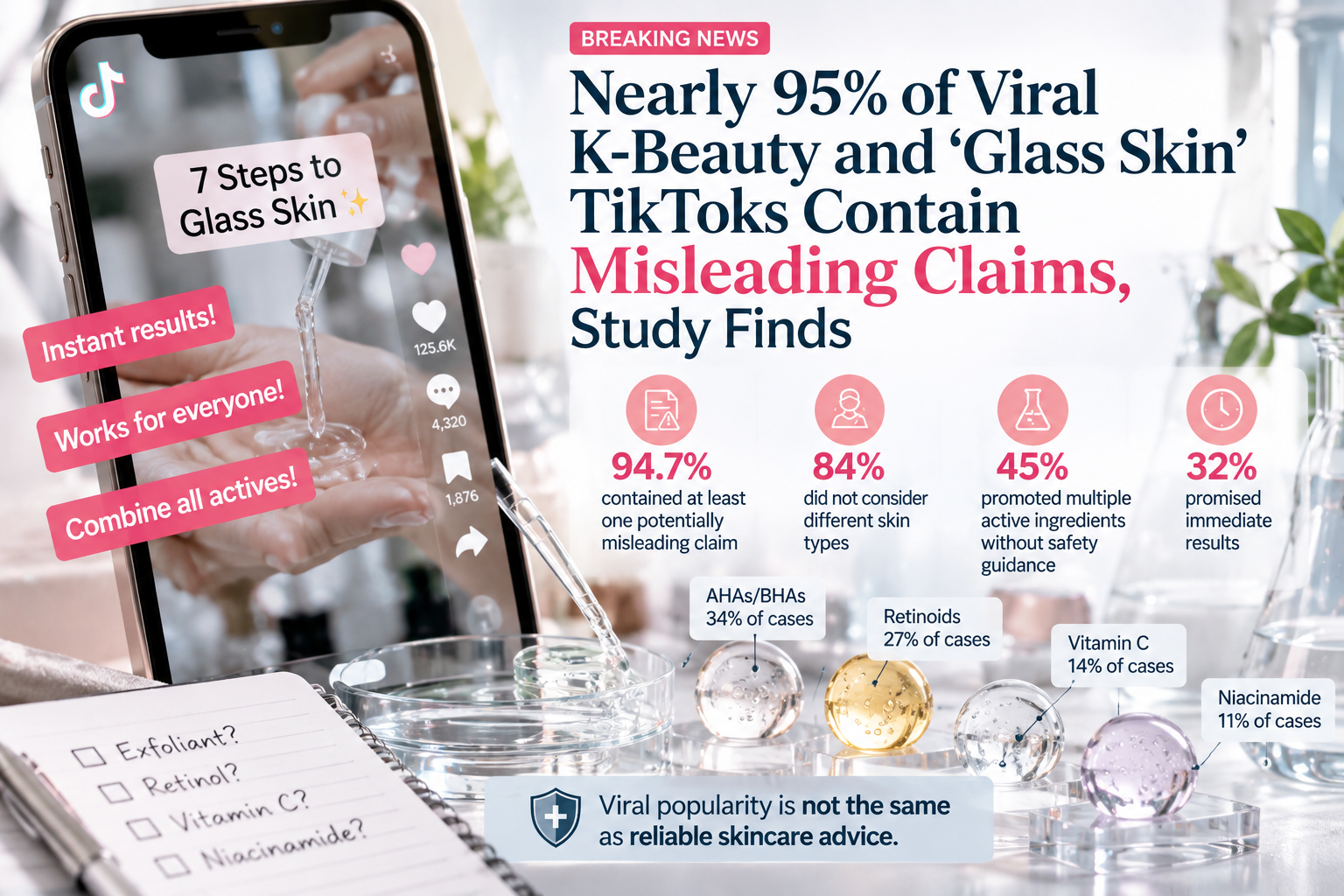
Nearly 95% of Viral K-Beauty and ‘Glass Skin’ TikToks Contain Misleading Claims, Study Finds
New research presented at EADV Congress 2026 raises questions about the accuracy and safety of viral Korean skincare advice on TikTok.
October 3, 2026 — Cosmetics Daily
The viral pursuit of “glass skin” has helped turn Korean skincare into a global beauty phenomenon. But new research suggests that some of the most popular advice circulating on TikTok may be missing important context.
Researchers examining viral Korean skincare and “glass skin” TikTok videos found that 94.7% contained at least one potentially misleading claim, according to research presented at the European Academy of Dermatology and Venereology (EADV) Congress 2026 in Vienna.
The study also found significant gaps in basic skincare safety information.
Among the 38 videos analyzed, 84% did not account for differences between skin types, while 45% promoted combinations of multiple active ingredients without adequate safety guidance. Another 32% promised immediate results.
The findings highlight a growing challenge for the beauty industry: skincare information can spread to millions of consumers faster than evidence-based guidance can keep up.
What Is the “Glass Skin” Trend?
“Glass skin” is a K-beauty term commonly used to describe skin that appears exceptionally smooth, clear, hydrated and luminous — creating an almost reflective, glass-like appearance.
The look has become particularly popular on TikTok, where creators share multi-step Korean skincare routines featuring cleansers, toners, essences, serums, exfoliants, moisturizers and sunscreens.
The problem, researchers suggest, is not necessarily the idea of glass skin itself.
Gentle cleansing, hydration and supporting the skin barrier can all form part of a sensible skincare routine.
Instead, concerns arise when these principles are transformed into viral, one-size-fits-all routines that combine multiple active ingredients or promise dramatic results without discussing potential risks.
Researchers Analyzed 38 Viral TikTok Videos
The researchers examined popular TikTok content related to Korean skincare and glass skin in May 2026.
To reduce the influence of TikTok's personalization algorithm, they used a neutral account with no previous engagement history and screened top-performing videos across five Korean skincare-related search terms.
After exclusions, 38 videos were assessed for dermatological claims, safety information, quality and reliability using established assessment tools.
The results were striking:
None of the analyzed videos cited an external scientific source or reference.
The researchers classified all 38 videos as unreliable or less reliable under the assessment methods used in the study.
Who Is Giving the Skincare Advice?
The study also examined who created the videos.
Nearly 82% were produced by non-physician influencers, while approximately 11% came from beauty brands and 8% from other beauty content creators.
None of the videos analyzed were produced by dermatologists.
That does not mean beauty creators cannot provide useful skincare information. But it highlights an important distinction between personal product experience and professional medical or dermatological advice.
As skincare content becomes increasingly technical — discussing ingredients such as retinoids, AHAs, BHAs, vitamin C and niacinamide — that distinction becomes more important.
The Bigger Risk May Be Mixing Too Many Actives
A separate observational study presented at the same EADV Congress examined 94 patients who developed a new or worsening skin condition after using cosmetic or dermatological products promoted on social media.
Chemical exfoliants containing AHAs or BHAs were the most frequently implicated products, reported in 34% of cases.
They were followed by:
The findings do not mean these ingredients are inherently unsafe.
AHAs, BHAs, retinoids, vitamin C and niacinamide are widely used skincare ingredients.
Instead, the research points toward the potential risks of following complex routines without considering concentration, frequency, ingredient combinations, individual skin type or existing skin conditions.
Why TikTok Skincare Advice Can Be Complicated
TikTok has fundamentally changed how consumers discover beauty products.
A skincare routine that once might have been recommended by a beauty editor, dermatologist or salesperson can now reach millions of viewers through a single creator.
That accessibility has helped consumers learn more about ingredients and discover brands from around the world.
It has also played a major role in the international rise of K-beauty.
But social media rewards content that is engaging, visual and easy to understand.
Skincare biology is often none of those things.
A dramatic before-and-after transformation or a “7-step glass skin routine” can therefore spread much faster than a nuanced explanation about skin types, irritation, patch testing or how long skincare products actually take to work.
Does This Mean the Glass Skin Trend Is Bad for Your Skin?
Not necessarily.
The new research should not be interpreted as evidence that Korean skincare or the glass skin concept itself is unsafe.
The study examined 38 popular TikTok videos, not every Korean skincare routine or every creator discussing K-beauty.
It also focused on the quality and reliability of information presented in those videos rather than testing whether K-beauty products themselves are harmful.
The more useful takeaway is that consumers should be cautious about treating viral skincare routines as universal instructions.
A routine that works well for someone with dry skin may not be appropriate for someone with acne, rosacea or sensitive skin.
Similarly, combining several individually useful active ingredients does not necessarily produce a better skincare routine.
How to Approach Viral Skincare Trends More Safely
Before copying a viral routine, consumers can ask a few simple questions:
Does this routine make sense for my skin type?
Dry, oily, acne-prone and sensitive skin may require very different approaches.
How many active ingredients am I using?
Adding multiple acids, retinoids or other potent ingredients at the same time can make it difficult to identify what is causing irritation.
Is the creator promising instant results?
Many meaningful skincare changes take weeks or months rather than days.
Is sunscreen part of the routine?
Some active ingredients can increase sensitivity to sunlight, making appropriate sun protection particularly important.
Where does the information come from?
Personal experience can be useful, but scientific evidence, qualified dermatologists and reliable ingredient information provide additional context.
The Beauty Industry Has a Credibility Opportunity
The study also reveals an opportunity for beauty brands, creators and dermatologists.
Consumers clearly want skincare education.
The enormous popularity of Korean skincare and glass skin content demonstrates that people are interested not only in buying products, but also in understanding routines and ingredients.
The next stage of beauty content may therefore be less about producing more viral skincare advice and more about producing better skincare advice.
Creators who explain limitations, identify skin-type differences and distinguish personal experience from scientific evidence may ultimately build greater trust.
Brands also have an opportunity to provide clearer guidance about ingredient combinations, irritation risks and realistic timelines for results.
And dermatologists may increasingly need to participate in the same social platforms where skincare misinformation spreads.
The Bottom Line
Glass skin remains one of the most influential beauty trends to emerge from K-beauty.
But the new research presented at EADV Congress 2026 shows how quickly a useful skincare concept can become oversimplified when translated into viral social media routines.
The study does not show that Korean skincare is unsafe.
It shows something more specific — and potentially more important:
viral popularity is not the same thing as reliable skincare advice.
As TikTok continues to shape what consumers buy and how they care for their skin, understanding that difference may become an increasingly important part of modern beauty literacy.