Breaking News
e.l.f. Beauty Reinvests $50 Million Tariff Refund into Lower Prices and Global Marketing
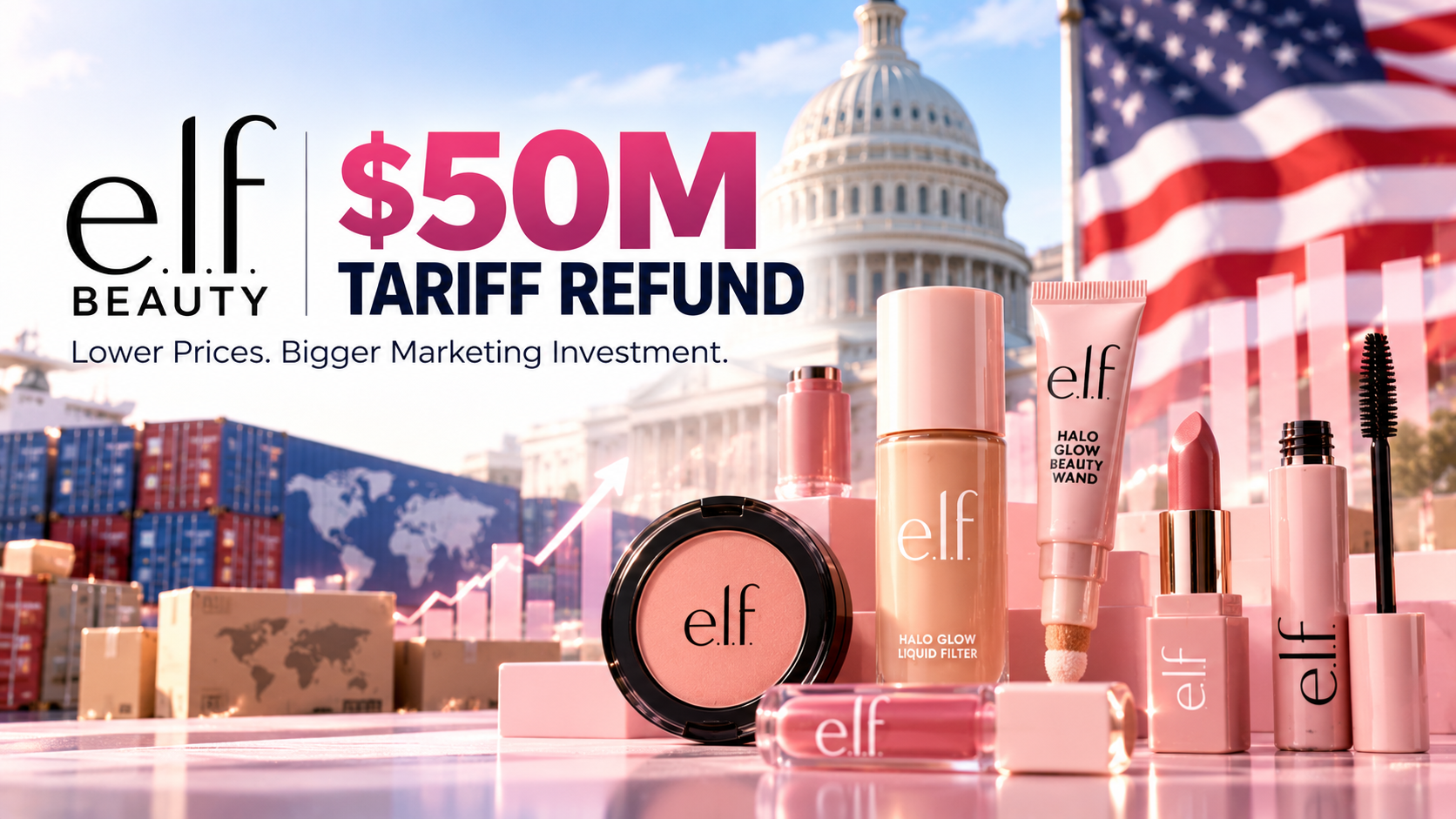
American cosmetics company e.l.f. Beauty is turning approximately $50 million in tariff refunds into a strategy focused on selective price reductions and increased international marketing investment.
The development, highlighted in industry reports on October 13–16, follows a US Supreme Court ruling that invalidated tariffs imposed under the International Emergency Economic Powers Act (IEEPA).
For the beauty industry, the decision demonstrates how changes in US trade policy can directly influence product pricing, marketing budgets and international expansion.
How Did e.l.f. Beauty Receive $50 Million in Tariff Refunds?
e.l.f. Beauty has historically relied heavily on manufacturing in China, exposing the company to US import duties and changes in trade policy.
During 2025, the company faced tariff rates on Chinese imports ranging from 25% to as high as 170%, according to its regulatory filings.
In February 2026, the US Supreme Court ruled that IEEPA did not authorize the tariffs imposed under that law.
The ruling opened the way for eligible importers to seek refunds of previously paid duties.
According to e.l.f. Beauty's quarterly filing, the company received approximately $51.1 million in tariff refunds during the three months ended June 30, 2026, plus $2.1 million in applicable interest.
The refunds provided additional financial flexibility for the company, although other trade duties and regulatory uncertainties remain.
e.l.f. Beauty Keeps Lower Prices on 10% of Its Products
Rather than applying broad price cuts across its entire portfolio, e.l.f. Beauty has taken a more selective approach.
The company previously raised prices on many products in response to tariff costs and inflationary pressures.
It subsequently tested lower prices across a large portion of its assortment to understand how consumers responded.
Management found that approximately 90% of products were appropriately priced at their existing levels.
However, around 10% of products generated significantly stronger unit sales when offered at lower prices.
The company therefore decided to maintain reduced prices on those selected products while restoring previous prices on the remainder.
The approach illustrates how consumer demand data can help beauty companies balance affordability with profitability.
Price Testing Shows the Importance of Consumer Value
One example of e.l.f.'s pricing strategy involved its Halo Glow Skin Tint.
The company previously tested reducing the product's price from $18 to $14.
Management reported a substantial improvement in unit sales following the reduction, demonstrating that some products may generate stronger demand at a lower price point.
The results also show why price reductions do not necessarily produce the same outcome across every product category.
For beauty brands, effective pricing requires understanding consumer demand, competitive positioning and the relationship between sales volume and margins.
More Marketing Investment in the UK, Canada and Germany
e.l.f. Beauty also plans to reinvest tariff-related financial benefits into marketing.
The company has identified the United Kingdom, Canada and Germany as important international growth markets.
Its strategy includes expanding brand awareness, strengthening retail partnerships and supporting product innovation.
Marketing expenditure for the fiscal year ending March 2027 is expected to approach the upper end of the company's guidance range of 23% to 25% of net sales.
The company has also emphasized opportunities to expand its presence through retailers including Boots and Sephora.
Rather than treating tariff refunds solely as additional profit, e.l.f. is using the funds to support its competitive position.
Why Trump's Tariff Policies Matter for Beauty Brands
The e.l.f. Beauty case highlights the relationship between trade policy and the economics of affordable cosmetics.
Import tariffs can increase the cost of finished beauty products, packaging materials and manufacturing inputs.
Companies must then decide whether to absorb those costs, raise retail prices, change suppliers or adjust their product portfolios.
When tariffs are reduced or refunded, companies may gain additional flexibility to invest in pricing, marketing or operations.
However, the Supreme Court ruling did not eliminate every US import tariff.
Other duties and trade measures may still apply, particularly to goods imported from China.
For cosmetics manufacturers and distributors, tariff classification, sourcing strategy and regulatory compliance therefore remain important considerations.
What Does This Mean for Consumers Facing Inflation?
Affordability has become an important consideration for consumers managing higher household expenses.
Although cosmetics and skincare remain popular categories, shoppers may become more selective when comparing products and prices.
Affordable beauty brands such as e.l.f. compete partly by offering accessible alternatives to higher-priced prestige products.
Selective price reductions may help retain price-sensitive customers and encourage additional purchases.
However, lower import costs do not guarantee that all beauty products will become cheaper.
Retail pricing continues to depend on production expenses, logistics, competition and company strategy.
Why It Matters for the Beauty Industry
The e.l.f. Beauty tariff refund offers three important lessons for cosmetics companies.
First, trade policy can affect beauty pricing strategies. Changes in import duties may influence whether brands raise prices, reduce prices or invest in other areas.
Second, data-driven pricing is becoming increasingly important. Testing consumer responses can help companies identify where lower prices generate meaningful additional demand.
Third, international marketing remains a major growth priority. e.l.f.'s focus on the UK, Canada and Germany shows how financial flexibility can support brand expansion beyond the domestic market.
For independent beauty brands and manufacturers, the case also reinforces the importance of monitoring trade policy and understanding the true landed cost of products.
What Comes Next?
e.l.f. Beauty expects to deploy its tariff-related reinvestment across the remaining quarters of fiscal 2027.
Investors and industry observers will be watching whether selective price reductions improve unit sales and whether increased marketing investment strengthens international growth.
The broader beauty industry will also continue monitoring US tariff developments and their potential effects on manufacturing costs and retail prices.