Breaking News
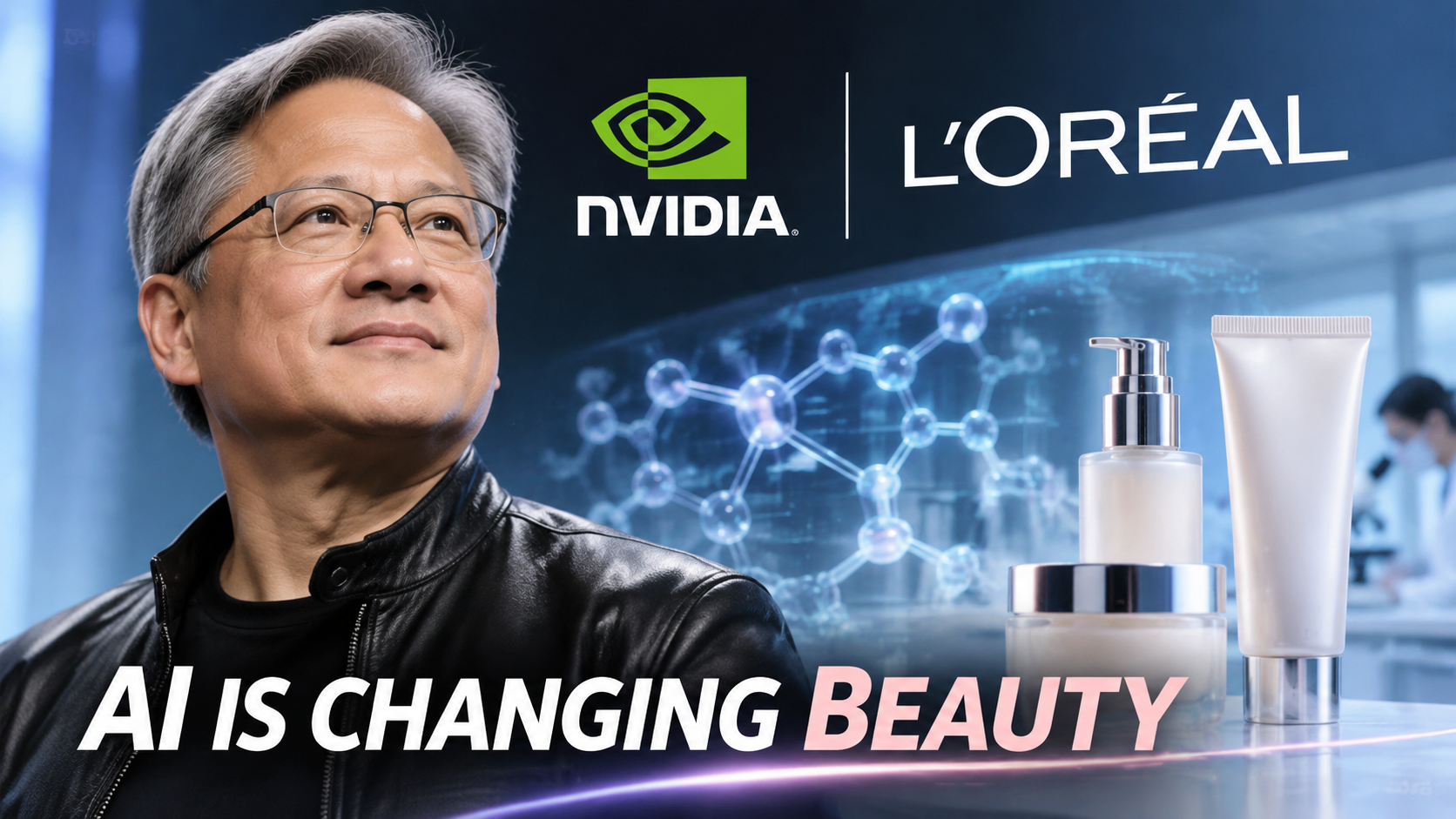
Jensen Huang’s NVIDIA Teams Up With L’Oréal to Develop AI-Powered Skincare 100 Times Faster
The beauty industry is getting an artificial intelligence upgrade. L'Oréal, the world's largest beauty company, is expanding its partnership with NVIDIA, the AI technology giant led by Jensen Huang, to accelerate the discovery of new skincare ingredients and cosmetic formulations.
Announced on March 17, 2026, the expanded partnership integrates NVIDIA's ALCHEMI machine learning framework into L'Oréal's research and innovation operations. According to L'Oréal, the technology could make its ingredient discovery process up to 100 times faster than traditional methods, potentially changing how future skincare and sunscreen products are developed.
NVIDIA AI Could Transform How Skincare Products Are Developed
Traditionally, developing a new skincare formula requires extensive laboratory testing. Scientists must evaluate different ingredient combinations, examine their chemical properties and determine how they interact before arriving at a finished formulation.
NVIDIA ALCHEMI aims to make this process significantly more efficient.
By using AI-powered computational chemistry, L'Oréal researchers can simulate how molecules interact at the atomic level and predict ingredient performance in a virtual environment. Instead of physically testing every possible combination, scientists can screen thousands of variables through computer simulations before moving promising formulations into laboratory testing.
L'Oréal says this approach can accelerate the discovery process by up to 100 times compared with traditional methods.
Sunscreen Is One of the First Major Areas of Focus
One of the most interesting applications involves sunscreen development.
Creating effective sunscreen formulations is particularly challenging because scientists must balance UV protection with texture, stability and consumer experience.
Consumers want products that provide reliable sun protection without leaving a visible white cast, feeling heavy or interfering with makeup application.
NVIDIA's technology could help L'Oréal researchers evaluate molecular combinations and identify promising sunscreen formulations more efficiently.
The partnership is also targeting skin tone management, another important area of skincare research. By simulating ingredient performance before physical testing, L'Oréal hopes to develop more precise formulations for skin protection and other beauty needs.
What This Means for the Future of Beauty
The partnership represents a bigger shift in the cosmetics industry: artificial intelligence is moving beyond virtual makeup try-ons and personalized shopping into the scientific development of beauty products.
For consumers, faster formulation research could eventually mean more innovative sunscreens, improved skincare ingredients and products developed with greater scientific precision.
However, AI-generated predictions do not automatically mean a finished product is ready for sale. New formulations will still need appropriate laboratory testing, safety assessments and product validation.
L'Oréal's expanded partnership with NVIDIA demonstrates how major beauty companies are increasingly turning to advanced AI technology to gain an advantage in product innovation.
As Jensen Huang's NVIDIA continues to expand its influence beyond traditional computing, the beauty industry is becoming another unexpected market where AI could make a significant impact.