Breaking News
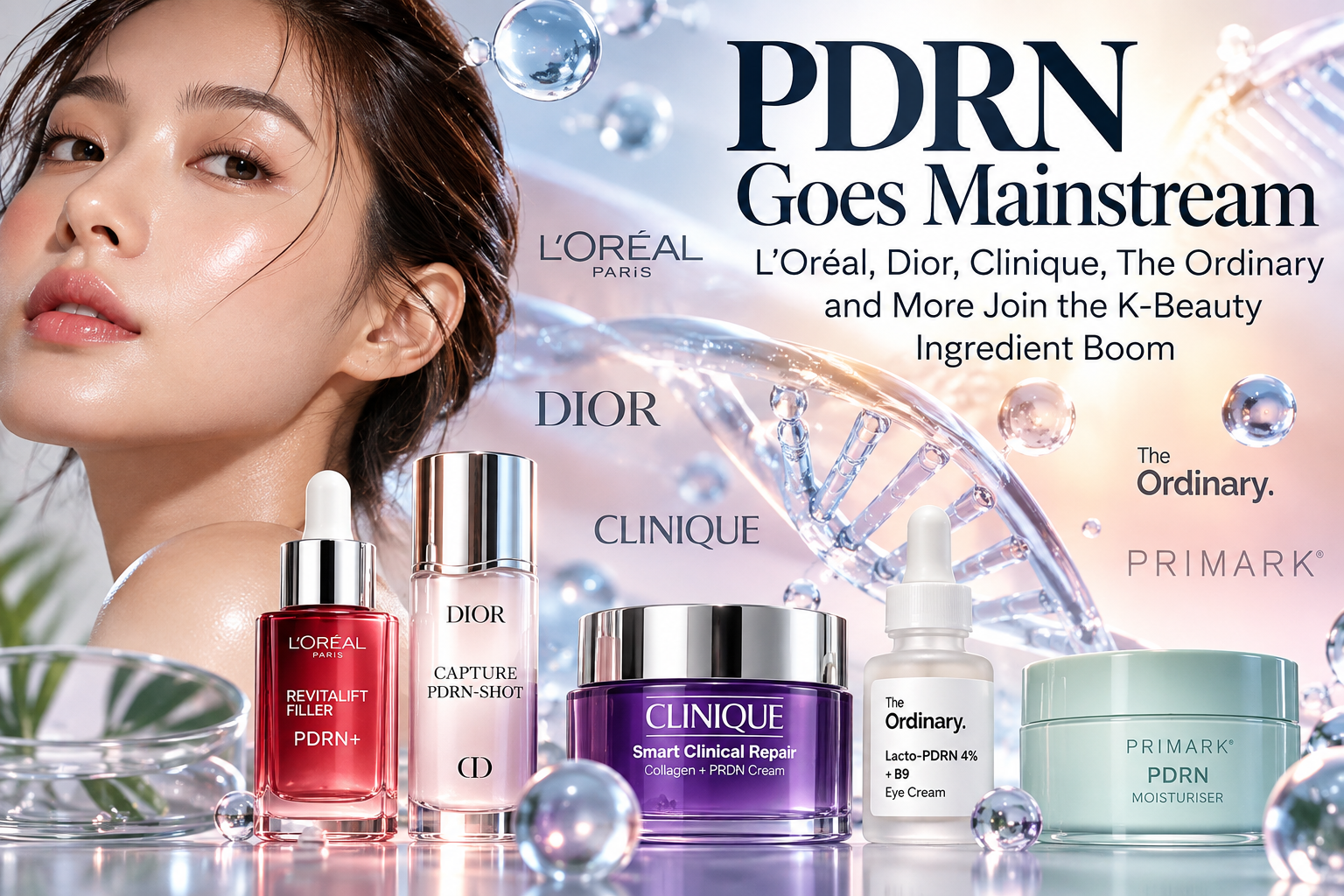
PDRN Goes Mainstream as L’Oréal, Dior, Clinique and The Ordinary Join the K-Beauty Ingredient Boom
From K-beauty clinics to mass-market skincare, PDRN is becoming one of 2026’s fastest-growing beauty ingredients.
October 3, 2026 — Cosmetics Daily
PDRN is moving beyond its K-beauty roots and into the global skincare mainstream.
Once best known as an injectable treatment associated with South Korean aesthetic clinics, PDRN — short for polydeoxyribonucleotide — is now appearing in products from some of the beauty industry’s biggest names.
L’Oréal Paris, Dior, Clinique, The Ordinary, Medik8, Byoma and even value retailer Primark have all introduced PDRN-based skincare, spanning everything from serums and eye creams to moisturizers and masks.
The wave of launches signals a significant shift: PDRN is no longer simply a viral Korean skincare ingredient. It is becoming a global skincare category.
What Is PDRN?
PDRN refers to fragments of DNA traditionally obtained from salmon-derived sources. It has a history of use in regenerative medicine and later became associated with injectable aesthetic treatments in South Korea.
Its transition into topical skincare, however, is taking a different direction.
A growing number of beauty brands are developing plant-derived, fermentation-based or other biotech alternatives rather than relying on traditional salmon-derived PDRN.
That distinction could become increasingly important as PDRN moves into mainstream cosmetics, where consumers are paying more attention to vegan formulas, ingredient sourcing and biotechnology.
L’Oréal, Dior and Clinique Bring PDRN to Mainstream Beauty
One of the clearest signs of PDRN’s growing influence is the diversity of brands now adopting it.
L’Oréal Paris has updated its Revitalift Filler serum with hyaluronic acid and its own biotech PDRN+, which the company describes as vegan and produced through biofermentation.
At the luxury end of the market, Dior has launched Capture PDRN-Shot, formulated with plant-derived PDRN alongside vitamin Cg and niacinamide.
Clinique has also entered the category with Smart Clinical Repair Collagen + PDRN Cream, using biotech-derived PDRN associated with Centella asiatica.
Meanwhile, The Ordinary has taken an ingredient-focused approach with Lacto-PDRN 4% + B9 Eye Cream, its first eye cream. The brand uses PDRN produced through controlled fermentation involving Lactobacillus rhamnosus.
The trend extends beyond prestige beauty.
Primark is introducing an entire seven-product PDRN skincare range using vegan PDRN derived from camellia flower, with prices starting at £2.50.
That range may be particularly significant: an ingredient once associated with relatively expensive aesthetic procedures is now appearing in mass-market skincare at extremely accessible price points.
Why Is PDRN Suddenly Everywhere?
Consumer interest appears to be accelerating rapidly.
According to data from Spate cited by Cosmetics Business, PDRN is generating an average of 37.2 million monthly interactions across Google, TikTok and Instagram, with year-over-year growth of 609.8%.
K-beauty brands including Medicube, Rejuran, Anua, Genabelle and VT Cosmetics currently account for substantial consumer interest around the ingredient.
But Western beauty companies are quickly catching up.
PDRN also sits at the intersection of several of skincare’s biggest current trends: K-beauty, skin longevity, barrier support, biotechnology and the broader shift away from aggressive exfoliation toward products positioned around maintaining healthier-looking, resilient skin.
Salmon PDRN vs. Vegan PDRN Could Be the Next Big Conversation
As more products reach the market, not all PDRN skincare will necessarily mean the same thing.
Traditional PDRN has commonly been associated with salmon-derived DNA. Newer cosmetic formulations increasingly highlight plant-based or biotech-derived alternatives.
Dior describes its PDRN as plant-derived. Clinique uses a biotech-derived version linked to Centella asiatica. The Ordinary uses fermentation technology, while L’Oréal Paris promotes a vegan biotech PDRN+.
This creates a new question for consumers:
Is salmon-derived PDRN different from vegan or biotech PDRN — and does the source affect how well a topical skincare product works?
The answer is not yet straightforward.
While PDRN has a history in regenerative medicine and aesthetic procedures, evidence for topical cosmetic PDRN is still developing. Experts also caution against assuming that a PDRN serum or cream will deliver the same effects as injectable treatments.
For topical products, factors such as molecular characteristics, delivery systems, concentration and the overall formulation may be just as important as the presence of PDRN itself.
What Comes Next for PDRN Skincare?
The latest launches suggest that PDRN has reached a turning point.
It has moved from Korean aesthetic clinics to K-beauty skincare, from K-beauty into Western prestige brands, and now from prestige beauty into mass-market retail.
The next phase will likely be less about whether a product contains PDRN and more about which type of PDRN it uses, where it comes from, how it is formulated and what evidence supports the finished product’s claims.
For consumers, that distinction matters.
For beauty brands, it means simply adding “PDRN” to a product label may soon no longer be enough.